


Why Patients Choose Non-Surgical Spinal Decompression
Back pain can change the way you work, sleep, exercise, drive, and enjoy everyday life. When pain starts interfering with normal activities, many patients begin looking for relief that does not immediately involve injections, medications, or surgery. For people dealing with certain disc and nerve-related conditions, non-surgical spinal decompression may provide a conservative treatment option designed to reduce pressure on the spine while supporting improved movement and function.
At HealthWorks, our approach focuses on understanding each patient’s condition and creating care plans around individual needs. We provide chiropractic care, spinal decompression, and several advanced therapies under one roof, allowing us to take a broader approach to pain management and recovery. Our goal is not simply to address discomfort for a short period, but to help patients work toward better mobility and long-term spinal health.
For qualifying patients, our non-surgical spinal decompression therapy is designed to address pressure involving spinal discs and surrounding structures. It may be considered for conditions such as herniated or bulging discs, sciatica, degenerative disc disease, facet syndrome, spinal stenosis, and certain post-surgical rehabilitation needs.
What Is Non-Surgical Spinal Decompression?
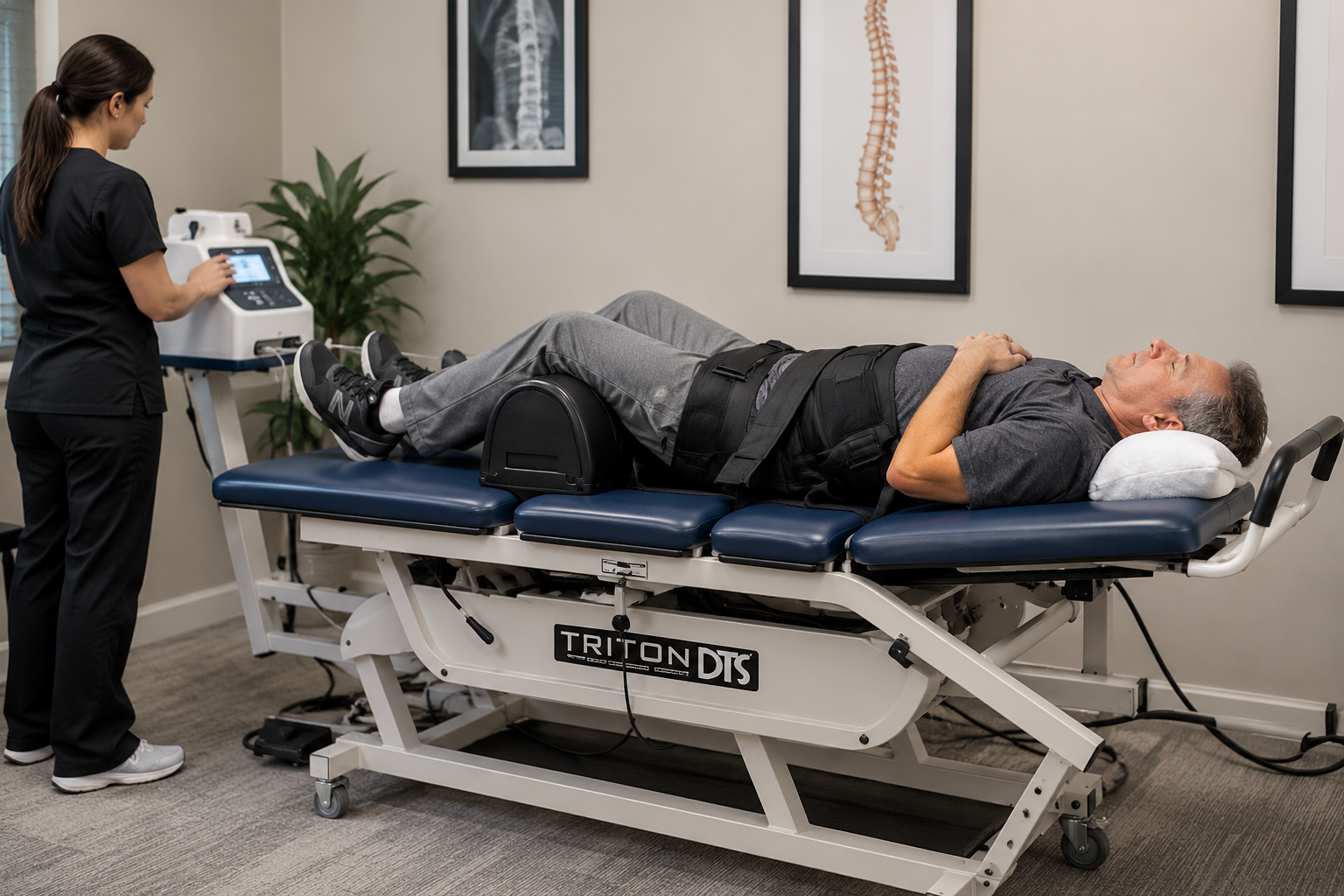
Non-surgical spinal decompression is a controlled form of spinal traction performed with specialized computerized equipment. Rather than using a constant pulling force, our decompression system uses carefully controlled cycles of unloading and relaxation while positioning the body to target a specific area of the spine.
At HealthWorks, the treatment table allows our team to adjust the decompression angle and targeted spinal zone according to the patient’s condition. The computerized system and split-table design are intended to provide targeted decompression while minimizing unnecessary friction and muscle guarding.
The objective is to reduce mechanical stress on affected spinal structures. When discs are compressed or irritated, pressure can contribute to pain and symptoms that may radiate into the arms or legs. By gently unloading the affected area, decompression therapy may help reduce pressure and create conditions that support the body’s natural healing processes.
This makes spinal decompression different from simply stretching the back. Treatment is individualized rather than relying on the same force or positioning for every patient.
Why Patients Consider Spinal Decompression
One of the biggest reasons patients choose non-surgical spinal decompression is simple: they want another option before considering surgery.
Surgery can be appropriate and necessary for certain spinal conditions, but it is not automatically the first choice for every patient experiencing back or neck pain. Depending on the underlying condition, symptoms, medical history, and overall health, conservative care may be worth exploring first.
Our team evaluates the patient’s situation before recommending decompression therapy. When appropriate, this approach allows us to work toward reducing symptoms while maintaining a focus on mobility, function, and rehabilitation.
Patients may consider decompression when they are experiencing:
Lower back pain
Neck pain
Sciatica or radiating leg discomfort
Radiating arm discomfort
Herniated discs
Bulging discs
Degenerative disc disease
Certain forms of spinal stenosis
Facet-related discomfort
Ongoing spinal discomfort following an injury
Certain post-surgical rehabilitation needs
Our website specifically identifies herniated and bulging discs, sciatic nerve pain, degenerative disc disease, post-surgical rehabilitation, facet syndrome, and spinal stenosis among conditions for which non-surgical spinal decompression may be used.
A Conservative Approach to Disc-Related Pain
Intervertebral discs sit between the vertebrae and help absorb the forces created by everyday movement. Over time, injury, repetitive stress, aging, and other factors can contribute to disc degeneration, bulging, or herniation.
When a disc becomes irritated or displaced, nearby nerves may also become affected. This can contribute to symptoms such as localized back or neck pain, numbness, tingling, or radiating discomfort.
Our decompression services are designed to address the mechanical component of these problems by gently unloading targeted areas of the spine.
The goal is not to promise that every disc problem can be corrected through decompression. Every patient’s condition is different, and results vary. Instead, our team focuses on determining whether this conservative approach makes sense for the individual patient.
That evaluation is important because spinal pain can have many causes. The same symptom can develop from different underlying conditions, which means treatment should be based on an appropriate assessment rather than simply treating the location of pain.
What Does a Spinal Decompression Session Feel Like?
Many patients are concerned that spinal treatment will be painful. Modern decompression therapy is designed to be gentle and controlled.
During treatment, the patient lies comfortably on the decompression table while our team positions and secures the appropriate support system. The computerized equipment then applies carefully controlled decompression to the targeted spinal area.
HealthWorks describes the typical experience as gentle and relaxing, with intermittent pulling sensations along the spine. Treatment is adjusted according to the patient’s condition rather than using one fixed approach for everyone.
A typical session lasts approximately 20 to 30 minutes, although treatment time can be adjusted according to individual needs.
Patients may be able to relax during the session, and some find the treatment comfortable enough to rest while the equipment performs the controlled decompression cycles.
How Many Treatments Are Needed?
There is no single number of sessions that works for every patient.
At HealthWorks, our website explains that a qualifying patient will generally undergo a series of decompression treatments combined with customized exercises. The average treatment plan is approximately eight weeks, with treatment commonly scheduled three times per week, although the exact schedule can change according to the patient’s progress and condition.
Some patients may notice changes relatively early in their treatment. However, feeling better after a few sessions does not necessarily mean the underlying rehabilitation process is complete.
Our team regularly evaluates progress and can adjust treatment frequency when appropriate. This allows the care plan to evolve as the patient’s condition changes.
Why Combine Decompression With Therapeutic Exercises?
Spinal decompression is not necessarily intended to function as a stand-alone solution.
The muscles surrounding the spine play an important role in stability, posture, movement, and daily function. If these supporting structures remain weak or poorly conditioned, spinal problems may continue to affect movement even after symptoms improve.
That is why our approach can include therapeutic exercises alongside decompression.
Exercises may help improve:
Core and spinal stability
Strength
Mobility
Functional movement
Support around the spine
Physical conditioning
Our website also notes that supportive therapies such as heat, electrical stimulation, and joint mobilization may be incorporated when appropriate to help reduce muscle spasms and inflammation, improve mobility, and support strength and stability.
The specific combination depends on the individual patient and the condition being treated.
An Alternative to Simply Managing Pain
Pain medications may provide temporary relief for some patients, but many people want to explore approaches that address the mechanical factors contributing to their symptoms.
Non-surgical spinal decompression gives qualifying patients another conservative option to discuss with our team.
The purpose is not to claim that decompression can eliminate every source of back pain. Instead, the treatment is intended to address certain spinal conditions by reducing mechanical pressure and supporting rehabilitation.
At HealthWorks, spinal decompression is part of a larger range of services. Our clinic provides chiropractic care, decompression therapy, EMTT therapy, Shockwave Therapy, massage therapy, and other technology-based treatments.
Having multiple services available allows us to consider the patient’s overall condition rather than automatically applying the same treatment to every type of pain.
Who May Be a Candidate?
Patients with certain disc and nerve-related conditions may be candidates for non-surgical spinal decompression.
For example, someone experiencing persistent back pain associated with a herniated or bulging disc may benefit from an evaluation. A patient experiencing symptoms associated with sciatica may also be appropriate for consideration.
However, being diagnosed with a particular condition does not automatically mean decompression is appropriate.
Our team needs to consider symptoms, medical history, physical findings, previous treatment, and overall health before developing a treatment plan. This helps us determine whether decompression is appropriate or whether another approach may better match the patient’s needs.
A proper evaluation is especially important when symptoms include significant weakness, progressive neurological changes, severe or unexplained pain, or other concerning signs requiring medical attention.
The HealthWorks Difference
At HealthWorks, our goal is to provide comprehensive care in a friendly, family-oriented environment. Our clinic serves the Summerville community with chiropractic and spinal decompression services alongside advanced therapies designed to support pain relief, mobility, and wellness.
Our team understands that no two patients experience pain in exactly the same way. Treatment therefore needs to account for the individual rather than simply focusing on a diagnosis written on a chart.
We take time to understand what is happening, how symptoms affect daily activities, and what the patient hopes to accomplish through care.
For someone struggling to sit comfortably, sleep through the night, walk normally, exercise, work, or participate in family activities, improving function can be just as important as reducing pain.
That is why our focus extends beyond temporary symptom management.
Frequently Asked Questions
Is spinal decompression surgery?
No. Non-surgical spinal decompression does not involve an incision or surgical procedure. It uses specialized computerized equipment to apply controlled decompression to targeted areas of the spine.
Can spinal decompression help a herniated disc?
It may help qualifying patients with herniated discs by reducing mechanical pressure on affected spinal structures. HealthWorks specifically offers non-surgical spinal decompression for qualifying patients with herniated and bulging discs.
Can decompression help sciatica?
Spinal decompression may be considered when sciatic symptoms are associated with spinal disc or nerve compression. Our team evaluates the underlying cause of symptoms before recommending treatment.
Does spinal decompression hurt?
Treatment is designed to be gentle and comfortable. Patients commonly experience intermittent pulling sensations, although individual experiences vary.
How long does each treatment take?
The average decompression session lasts approximately 20 to 30 minutes. Treatment time may be adjusted according to individual needs.
How many treatments will I need?
Treatment plans vary. HealthWorks describes an average program of approximately eight weeks with three treatments per week, combined with customized exercises, although the schedule can be adjusted according to progress.
Can spinal decompression prevent surgery?
No treatment can guarantee that surgery will never be necessary. However, for appropriate patients, non-surgical decompression may provide a conservative treatment option that can be explored before surgery is considered.
Will my pain stay away permanently?
No provider can guarantee permanent pain relief. Our goal is to address contributing factors, improve function, support rehabilitation, and provide patients with strategies that may help maintain their progress. Continued exercises and healthy movement habits can be important parts of long-term spinal health.
Conclusion
Choosing how to manage back or neck pain is an important decision. For some patients, surgery may eventually be necessary. For others, a conservative treatment approach may provide an opportunity to improve symptoms and function without undergoing an operation.
Non-surgical spinal decompression offers a controlled, technology-based approach for qualifying patients dealing with certain disc and nerve-related conditions. At HealthWorks, our team combines decompression therapy with individualized care and supportive rehabilitation when appropriate.
If persistent back pain, neck pain, sciatica, a herniated disc, or degenerative disc disease is affecting your daily life, an evaluation can help determine what treatment options may be appropriate for your situation.
You do not have to assume that surgery is your only option for spinal pain. Our team can evaluate your condition, discuss your symptoms, and determine whether non-surgical spinal decompression belongs in your personalized care plan.
HealthWorks of Summerville
📍 Address: 1240-A Central Ave, Summerville, SC 29483
📞 Phone: (843) 821-8787
🌐 Website: healthworksmed.com
Contact our team today to learn more about Decompression Therapy and take the next step toward improving comfort, mobility, and your ability to stay active.