


Why Matrix Therapy Is Gaining Attention in Rehabilitation
Pain can change the way a person moves, works, sleeps, exercises, and enjoys everyday life. When discomfort continues, rehabilitation is often about more than simply making pain disappear. The goal is to help the body move better, restore function, reduce irritation, and support a return to normal activities. That is one reason Matrix Therapy is gaining attention as a non-invasive option for people dealing with nerve, muscle, joint, and soft-tissue discomfort.
At HealthWorks of Summerville, our team uses The Matrix Treatment as part of a broader approach to pain relief and rehabilitation. Our service is designed to target problem areas with controlled therapeutic stimulation while supporting mobility and the body’s natural recovery response. According to our Matrix Treatment page, the therapy may be used for back pain, neck pain, sciatic nerve discomfort, muscle tension, joint pain, nerve irritation, radiating arm or leg discomfort, soft-tissue pain, and chronic pain conditions.
What Is Matrix Therapy?
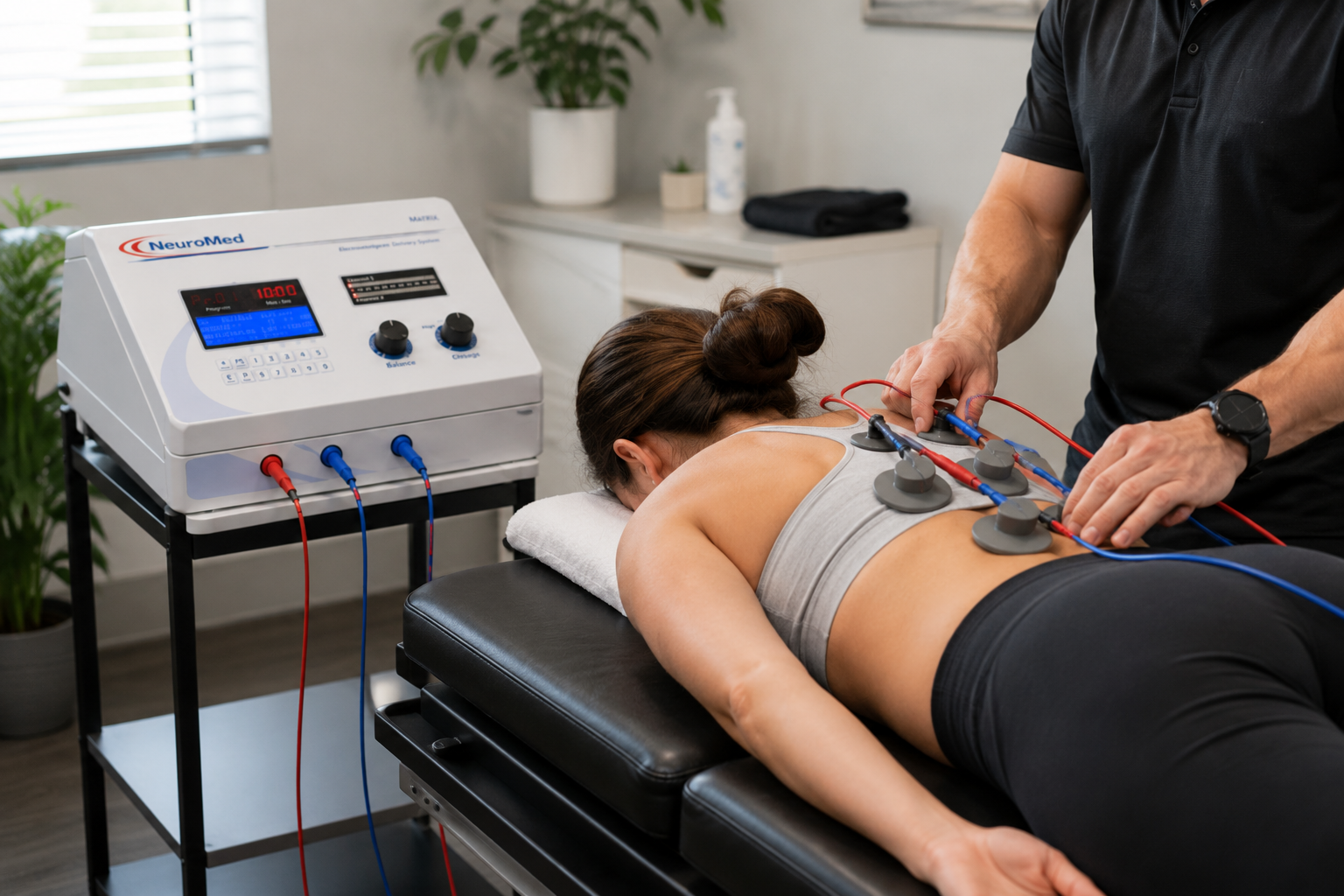
The Matrix Treatment is a non-invasive therapy that uses specialized electrode pads or suction-cup applicators placed over the area being treated. The device delivers controlled therapeutic stimulation to the targeted region. Our goal is to help calm pain signals, reduce muscle tension, support circulation in the treatment area, and encourage the body’s recovery processes.
For rehabilitation, that combination can be important. Pain may cause a person to guard an area, change posture, avoid movement, or rely on other muscles to compensate. Over time, those changes can contribute to stiffness, weakness, and reduced mobility. A comfortable therapy that supports pain management may make it easier for a patient to participate in appropriate movement and other parts of a personalized care plan. This emphasis on restoring function and returning to activity is consistent with approaches used in established pain-rehabilitation programs.
Matrix Therapy is not a surgical procedure, and our service does not require injections. HealthWorks describes the treatment as non-surgical and drug-free, with most patients able to return to normal daily activities afterward, depending on their individual condition and recommendations.
Why Is Matrix Therapy Getting Attention?
Rehabilitation is increasingly focused on individualized care rather than relying on one treatment for every patient. Our approach reflects that philosophy. We evaluate symptoms, consider the underlying problem, and determine which services may fit the person’s needs and goals.
Matrix Therapy can be useful within this model because it is not limited to one type of complaint. Our treatment page identifies several areas where it may be considered, including nerve-related discomfort, muscle tension, back and neck pain, joint discomfort, and soft-tissue pain.
Another reason patients may be interested is the non-invasive nature of the treatment. People experiencing persistent discomfort may want options that do not involve surgery, injections, or prolonged recovery. Matrix Therapy provides a treatment experience in which patients can remain comfortably positioned while stimulation is delivered to the targeted area.
Potential Benefits for Rehabilitation
Pain relief is one of the primary reasons Matrix Therapy may be included in a rehabilitation plan. Our service is designed to help reduce pain and discomfort while addressing factors that can interfere with movement.
Improved mobility is another potential benefit. When pain and muscle tension make movement difficult, even simple activities can become challenging. By helping calm discomfort and relax tight muscles, treatment may support more comfortable movement.
Nerve irritation is another area of interest. Symptoms such as radiating discomfort, tingling, or irritation can interfere with normal activity. Our Matrix Treatment is designed to target affected areas and may be incorporated into a broader plan when nerve-related symptoms are present.
Muscle tension and spasms can also affect rehabilitation. A person may tighten muscles around a painful region as a protective response. This can create additional stiffness and make movement feel restricted. Matrix Therapy may help reduce muscle tension, allowing other rehabilitation strategies to be used more comfortably.
Our website also identifies circulation and tissue recovery as potential areas supported by the treatment. Healthy circulation is important because tissues depend on oxygen and nutrients for normal function and recovery.
Why Rehabilitation Needs More Than Symptom Management
A successful rehabilitation process is often measured by what a person can do, not only by how a person feels during a treatment session. Pain reduction can be valuable, but improved function is usually the objective. Being able to stand longer, walk farther, turn the head, lift safely, exercise, or complete household tasks can make a difference in daily life. Johns Hopkins Medicine similarly describes pain-management rehabilitation as being designed to help people return to the highest possible level of function and independence while improving quality of life.
That is why our team considers the role of each therapy within the patient’s plan. Matrix Therapy may help create a more comfortable environment for movement by addressing discomfort and muscle tension in a targeted area. When appropriate, it can be paired with active rehabilitation strategies designed to improve strength, flexibility, coordination, and movement habits.
This approach also allows care to evolve. Symptoms can change as recovery progresses, and treatment priorities may change with them. A therapy that is useful during an uncomfortable phase may later become one part of a maintenance or mobility-focused plan. Our goal is to keep treatment connected to the patient’s progress rather than using a fixed approach regardless of results.
Patients should also understand that rehabilitation is a process. Rest, activity, exercise, posture, daily habits, and professional care can all play a role. Matrix Therapy may support that process, but it does not replace healthy movement or a proper clinical evaluation. The National Institute of Neurological Disorders and Stroke (NIH) notes that pain management may involve different approaches, including physical therapy, lifestyle changes, behavioral approaches, and other treatments selected according to the individual.
For anyone considering this therapy, asking questions is encouraged. Understanding what is being treated and how Matrix Therapy fits with other services can help patients make informed decisions about care.
How Matrix Therapy Fits Into a Personalized Plan
At HealthWorks, we do not view Matrix Therapy as a replacement for evaluation or individualized care. Instead, our team may use it alongside other services when appropriate. Our website explains that The Matrix Treatment can be combined with chiropractic care, spinal decompression, Shockwave Therapy, Class IV Laser Treatment, EMTT Treatment, and therapeutic exercises.
This matters because rehabilitation often involves several contributing factors. For example, a patient with back discomfort may have pain combined with restricted movement and muscle tension. Another patient may have neck discomfort associated with irritation and limited mobility. A treatment plan should reflect those differences rather than treating every complaint identically.
Our broader service offering allows us to consider different therapeutic approaches within one care setting. HealthWorks offers chiropractic care, decompression therapy, EMTT, Shockwave Therapy, Class IV Laser Treatment, The Matrix Treatment, massage therapy, and other services. This gives our team multiple options when developing a plan around a patient’s symptoms and goals.
What Can a Matrix Treatment Session Feel Like?
During treatment, patients relax while electrode pads or suction-cup applicators are placed over the selected area. Controlled stimulation is then delivered through the device. Our website describes the experience for many patients as gentle, rhythmic, or relaxing.
The intensity can be adjusted according to comfort. The goal is not to create painful sensations. Instead, the treatment is intended to provide controlled therapeutic stimulation to the targeted area.
Session length and the number of treatments can vary. There is no single schedule that applies to everyone because the appropriate plan depends on symptoms, condition severity, response to care, and individual treatment goals. After an evaluation, our team can discuss whether Matrix Therapy fits into the recommended plan.
Who May Consider Matrix Therapy?
Matrix Therapy may be considered for adults experiencing several types of musculoskeletal or nerve-related discomfort. Our service page specifically lists back pain, neck pain, sciatic nerve discomfort, muscle tension and spasms, joint pain, nerve irritation, radiating arm or leg discomfort, soft-tissue pain, and chronic pain conditions.
However, having one of these symptoms does not automatically mean Matrix Therapy is appropriate. A proper evaluation remains important. Persistent, severe, unexplained, or worsening symptoms should be assessed so the underlying problem can be understood and the appropriate treatment selected.
For rehabilitation patients, the bigger question is often whether a therapy can support a meaningful functional goal. That might mean walking more comfortably, moving the neck more freely, returning to exercise, reducing muscle guarding, or participating more easily in therapeutic exercises.
A Modern, Non-Invasive Approach
The growing interest in therapies such as Matrix Treatment reflects a larger demand for non-invasive options that can fit into individualized rehabilitation programs. Patients often want care that addresses discomfort while also supporting movement and function.
Our goal at HealthWorks is to provide that type of patient-centered approach. We combine evaluation with therapies selected according to individual needs instead of assuming that one treatment works for everyone. Matrix Therapy can be one component of that process.
It is also important to maintain realistic expectations. No therapy produces identical results for every person, and our website specifically notes that results may vary by person. Matrix Treatment should therefore be viewed as one potential tool within a broader rehabilitation strategy, not as a guaranteed solution for every pain condition.
Frequently Asked Questions
Is Matrix Therapy invasive?
No. Our Matrix Treatment is described as a non-invasive therapy. It uses electrode pads or suction-cup applicators and controlled therapeutic stimulation rather than surgery or injections.
Can Matrix Therapy help with back and neck pain?
Our service page lists both back pain and neck pain among the conditions for which Matrix Therapy may help. An evaluation can help determine whether it is appropriate for a specific patient.
Can it be combined with other treatments?
Yes. When appropriate, our team may combine Matrix Therapy with chiropractic care, spinal decompression, Shockwave Therapy, Class IV Laser Treatment, EMTT Treatment, or therapeutic exercises.
Is the treatment painful?
The treatment is designed to be comfortable. Patients may feel mild stimulation, and our provider can adjust settings according to comfort.
How many sessions will I need?
There is no universal number. Treatment frequency depends on symptoms, condition severity, response to care, and individual goals. Our team can recommend a plan after evaluation.
Is there downtime?
Our website states that most patients can return to normal daily activities after treatment, although individual recommendations may vary based on the condition and care plan.
Conclusion
Matrix Therapy is gaining attention in rehabilitation because it offers a non-invasive way to address pain, muscle tension, nerve irritation, and mobility concerns while fitting into a broader personalized treatment plan. At HealthWorks of Summerville, our Matrix Treatment is designed to support pain relief, improved mobility, circulation, and the body’s natural recovery response.
Rehabilitation is not simply about choosing a therapy. It is determining which approach makes sense for the individual and using treatment strategically around meaningful goals. Our team can evaluate your symptoms and discuss whether Matrix Therapy, alone or alongside other HealthWorks services, may fit your needs.
If pain, stiffness, nerve irritation, or limited mobility is interfering with the activities you value, contact us to learn more about The Matrix Treatment and your available care options.
HealthWorks, Summerville Disc & Neuropathy Center
📍 Address: 1240-A Central Ave, Summerville, SC 29483
📞 Phone: (843) 821-8787
🌐 Website: healthworksmed.com